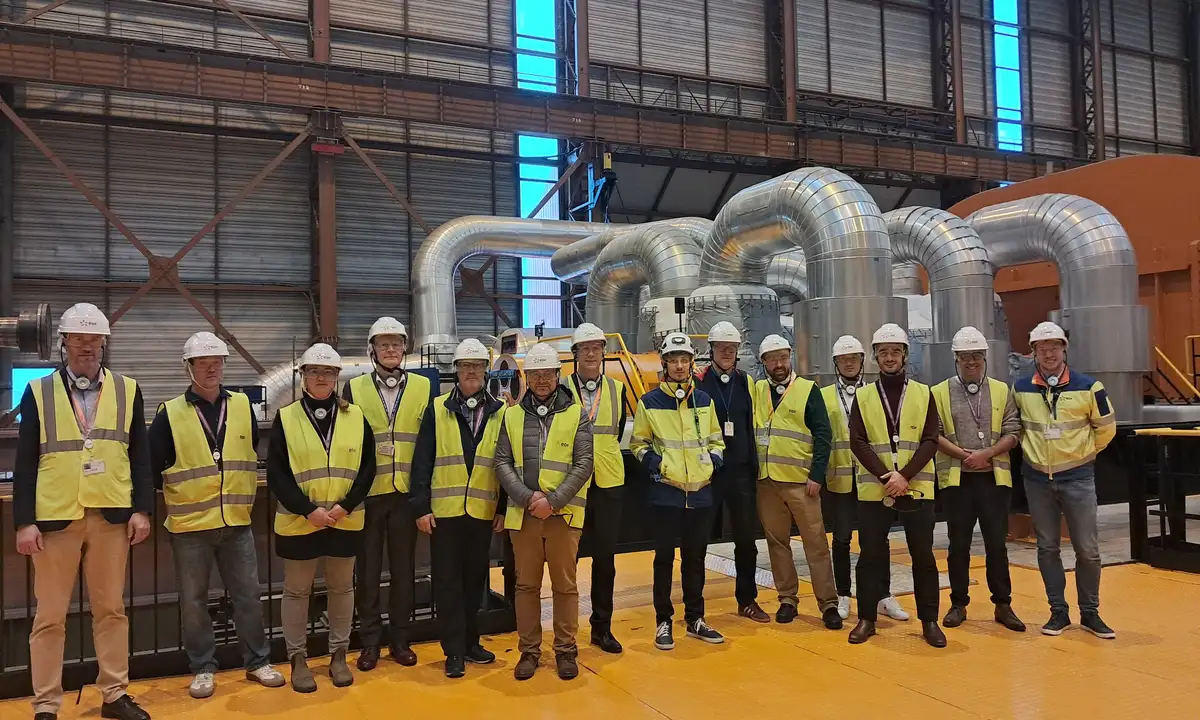
In November 2025, 40 performance specialists, nuclear experts, industry partners, and Metroscope team members gathered at Gravelines CNPE for Metroscope's annual Experience Sharing event (MEX 2025).
Bringing together operators, performance engineers, and site experts, the event was designed around a simple idea: some of the most valuable operational knowledge does not come from manuals or procedures. It comes from real situations encountered in the field, the decisions made to address them, and the lessons learned along the way.
Throughout the day, participants shared experiences from their own plants, discussed recurring challenges, and compared investigation practices. While the situations varied, many conversations converged around the same question: how can teams move more quickly and confidently from detecting a performance issue to deciding what action to take?
Turning experience into action
By bringing together participants from different organizations and operational contexts, MEX created opportunities to compare practices and discuss challenges that are often shared across the industry.
The discussions quickly highlighted a common observation: most costly performance losses do not begin with obvious failures. They start as weak signals—small deviations, unexpected trends, or subtle changes in equipment behavior that can easily go unnoticed or remain unprioritized.
Several participants emphasized the importance of quantifying these signals before action can be considered. A deviation becomes far easier to investigate when its consequences are expressed in operational terms, whether in megawatts, efficiency losses, or economic impact.
At Penly, a small leak on a reheater bypass valve led to a significant production loss. The deviation in steam flow was detectable, but it did not trigger action until its impact was quantified. Without this step, the issue would likely have remained unaddressed.
As discussions progressed, participants explored another recurring challenge: alignment.
Performance investigations often involve multiple stakeholders with different priorities. Translating technical findings into a common operational language helps teams build consensus and prioritize actions more effectively.
Discussions around a condenser cleaning system issue at Chooz illustrated this point. Initially considered a lower-priority topic, the issue gained visibility once the associated losses were quantified. The team was then able to justify corrective action during the next outage, with the benefits confirmed after restart.
What made these exchanges particularly valuable was not simply the sharing of success stories, but the opportunity to compare decision-making processes. Participants discussed how they evaluate uncertainty, how much evidence is needed before acting, and what helps build confidence in a diagnosis.
During restart phases at Tihange, where multiple deviations can emerge simultaneously, the ability to quickly isolate, assess, and prioritize issues is particularly valuable. Participants described how investigations that previously required weeks can now be completed within a matter of days.
Another theme emerged repeatedly throughout the event: effective investigations are rarely the result of a single tool or a single team.
Operators, performance engineers, maintenance teams, and field experts each contribute part of the picture. MEX2025 provided a forum to discuss how these different perspectives can be combined to reduce uncertainty and accelerate decision-making.
One example shared by the team from Gravelines involved a reheater valve leakage. Combining diagnostics with field observations and structured exchanges between teams helped reduce uncertainty and accelerate the decision process.
Taken individually, these cases addressed different technical issues. Together, they revealed a broader lesson: improving performance is not only about detecting anomalies. It is about creating the conditions that allow teams to understand their impact, build confidence in their diagnosis, and act at the right time.
.png)
Why experience sharing matters
Beyond the operational examples themselves, MEX2025 also created an opportunity to reflect on how investigation practices continue to evolve across the industry.
Participants identified several areas where improvements could further reduce investigation time and strengthen confidence in decisions:
- Expanding diagnostic coverage to capture a broader range of failure modes.
- Improving data quality and reliability to reduce uncertainty during investigations.
- Making diagnostic insights easier to interpret and share beyond specialist teams.
These discussions are valuable not only for participating sites, but also for Metroscope's product development. By understanding how investigations unfold in real operational environments, the team can better identify where monitoring solutions create value and where further improvements are needed.
Just as importantly, the event allows knowledge to circulate across sites. Less experienced teams gain access to proven approaches, while more mature organizations benefit from confronting their practices with different perspectives and operational contexts.
This exchange of experience is at the heart of MEX. It transforms individual lessons into collective knowledge and helps build a shared understanding of what drives effective performance investigations.

Continuing the conversation
The discussions at MEX2025 highlighted a challenge shared across many nuclear sites: reducing investigation time while increasing confidence in operational decisions.
While every plant faces its own technical realities, the questions raised during the event were remarkably similar. How do we identify the issues that matter most? How do we prioritize actions? How do we build enough confidence to act quickly?
By bringing together experts from different sites, MEX creates a space where these questions can be explored collectively and where operational experience becomes practical knowledge.
---
Interested in exchanging perspectives on performance investigations, diagnostic practices, or decision-making challenges at your site? Contact the Metroscope team to continue the conversation and explore how these lessons could apply to your operational context.
